
Women power, rebellious love, shady godmen, love triangles and more on OTT. Sukanya Verma lists everything coming up on OTT this week.

Earlier, Trump has already talked about slapping "100 per cent tariffs" on the BRICS grouping, a bloc that includes India as well.

Artificial Intelligence, innovation and next-generation technologies figured prominently during the high-stakes discussion between Prime Minister Narendra Modi and US President Donald Trump at the White House, as the two sides announced transformative measures, including the US-India TRUST initiative, roadmap on accelerating AI infrastructure and INDUS Innovation, to boost tech ties.

I'...additional concessions, such as opening government procurement, reducing agricultural subsidies, weakening patent protections, and allowing unrestricted data flows -- demands India has resisted for decades.'

The Centre is considering a proposal on increasing coverage under the Ayushman Bharat scheme to Rs 10 lakh from the current Rs 5 lakh.

With Donald Trump all set to become US president, Indian exporters may face high customs duties for goods like automobiles, textiles and pharmaceuticals if the new US administration decides to pursue the 'America First' agenda, opined trade experts. Experts also said that Trump could also tighten H-1B visa rules, impacting costs and growth for Indian IT firms. Over 80 per cent of India's IT export earnings come from the US, making it vulnerable to changes in visa policies.

Foreign direct investment (FDI) inflows into India have crossed the $1 trillion milestone in the April 2000-September 2024 period, firmly establishing the country's reputation as a safe and key investment destination globally. According to data from the Department for Promotion of Industry and Internal Trade (DPIIT), the cumulative amount of FDI, including equity, reinvested earnings and other capital, stood at $1,033.40 billion during the said period.

Net flows from domestic institutional investors crossed Rs 5 trillion for the first time during a calendar year.

Research and development (R&D) spending by BSE 100 companies has grown steadily, rising from 0.89 per cent of revenue in FY20 to 1.32 per cent in FY24, averaging around 1 per cent over the period in-between, according to data compiled from Bloomberg and company annual reports. Also, these companies more than doubled their R&D spending in absolute terms over these five years: From Rs 25,041 crore to Rs 63,072 crore. While this reflects a prioritisation of innovation, corporate R&D investment remains relatively conservative.

By understanding the elements that rule your birth number, you can learn how to enhance your professional journey, improve your work life and grow in your career.

Corporate India's struggle with subdued revenue and earnings growth persisted in the October-December quarter of 2024-25 (Q3FY25). The combined net sales (gross interest earnings for lenders) of listed companies grew in single digits for the seventh consecutive quarter, while their combined net profit rose by a single digit for the third straight quarter.

Analysts are expecting pharmaceutical companies to post sales growth of 10-11 per cent in the second quarter this financial year while the Ebitda (earnings before interest, tax, depreciation, and amortisation) margins are anticipated to improve by about 110 basis points. Ebitda improvement will be led by lower input costs because prices of active pharmaceutical ingredients (APIs) are 5-15 per cent lower year-on-year (Y-o-Y). Axis Capital said sales growth would be around 10 per cent, of which growth in the India market would be 11 per cent or so.

Rupee depreciation, if it continues, will likely pull the markets down further. Since September 2024, the rupee has declined by 3.1 per cent, the Nifty has dropped by 8.5 per cent during the same period, and the Sensex has fallen by 7.3 per cent. If the decline continues, markets will need to brace for more pain as it could push foreign portfolio investors (FPIs) to exit their positions faster than anticipated.

The collective wealth of the 100 richest went past $1 trillion for the first time.

Dabba Cartel's reluctant black comedy in the body of a crime thriller starts out interestingly enough to accomplish its Narcos: Thane aspirations, notes Sukanya Verma.

Here is a list of items set to become cheaper and costlier.

India's merchandise exports dipped by about one per cent to $38.01 billion in December 2024 against $38.39 billion a year ago, according to government data released on Wednesday. Imports increased by 4.8 per cent to $59.95 billion in December 2024 compared to $57.15 billion in the year-ago month.

While the April to September period (H1) saw as many as eight major deals worth over Rs 5,000 crore (Rs 50 billion), the second half of the year saw a sharp drop in the value of such deals to about Rs 1,500 crore (Rs 15 billion). Though the number of deals in H1 and H2 is almost the same, the sharp decline in value in the second half indicates a clear change in outlook and strategy of companies, say industry experts.

The stocks are largely from sectors such as chemicals, finance and cement, which struggled earlier but the worse seems to be behind them.

Barring a few, such as Andhra Pradesh Chief Minister N Chandrababu Naidu (74), Union Minister C R Patil (69) and Uttar Pradesh Finance Minister Suresh Khanna (71), most other ministers attending the WEF represent the next generation of India's politicians.

'A long-term investor with a 4 to 5 year horizon could invest in this theme via SIPs.'

Apple's ambitious strategy to expand iPhone exports, shift more production from China to India at a faster pace, and grow its domestic market hits a Trump-sized roadblock.

While this will incur a revenue loss amounting to 0.2 per cent of GDP, it will provide a strong boost to consumer sentiment and spending, points out Rajani Sinha.

After registering a net profit of Rs 25.1 crore in Q3FY25 and consolidated revenues growing by 7 per cent on a like-for-like basis, Siddharth Mittal, chief executive officer (CEO) and managing director, Biocon, told Sohini Das/Business Standard in a virtual interaction that local manufacturing in the US is a trade off between cost and qualifying to do business there.

The performance of banking and information technology (IT) stocks has had a significant impact on the composition of diversified mutual fund (MF) portfolios. Over the past two months, these sectors have become increasingly dominant, now constituting nearly 30 per cent of the total allocation in many diversified MF portfolios.

Do we have enough trained oncologists and medical professionals in India to man these over 4,500 beds in the public sector?

Among the commonly used analgesic formulations (painkillers) found NSQ are combinations of paracetamol with ibuprofen, diclofenac and mefenamic acid. Medications using these combinations are commonly used to treat fever, mild migraine, period and muscle pain.

This will be the first full-year Budget of the BJP-led National Democratic Alliance government since it came to power for a third consecutive term in July last year.

FDC drugs are those which contain a combination of two or more active pharmaceutical ingredients in a fixed ratio and are also referred to as 'cocktail' drugs.

Most of the pharma units are failing in documentation, and validation processes, and many don't have full-fledged quality control laboratories.
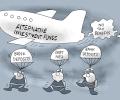
Alternative investment funds (AIFs) - investment vehicles favoured by the affluent - have topped $50 billion (Rs 4.3 trillion) in total investments for the first time during the April-June quarter, according to the latest data from the Securities and Exchange Board of India. The industry's commitments have approached Rs 12 trillion ($140 billion), marking a 40 per cent increase over the past year. The amount raised and deployed stood at Rs 4.74 trillion ($56 billion) and Rs 4.32 trillion ($51 billion), respectively, the data shows.

The revenue growth of Indian companies for the July-September quarter is estimated to be 5-7 per cent year-on-year (Y-o-Y), marking the slowest growth in 16 quarters, rating agency CRISIL said on Thursday.

'The shifts in US involvement in global conflicts and geopolitical alliances could introduce uncertainties.'

Exporters on Thursday sought a fund of Rs 750 crore for three years to tap USD 25 billion export potential in the US, aiming to seize potential opportunities that may arise as the US President-elect, Donald Trump, has threatened to impose high tariffs on Chinese goods. In its pre-Budget meeting with the finance ministry, Federation of Indian Export Organisations (FIEO) President Ashwani Kumar has also demanded extension of the five per cent Interest Equalisation Scheme (IES).

The Galwan clash occurred six months after the Doklam disengagement and two high-profile meetings. India should not be caught by surprise once again, asserts former foreign secretary Shyam Saran.

Donald Trump's Presidency of the United States will open new opportunities for India though certain sectors, especially pharma and IT, may face the heat if the incoming president decides to impose restrictions on imports and H1B visa regulations, experts said on Wednesday. Prime Minister Narendra Modi's friendly relationship with Trump will have a positive bearing on Indo-US relations but India may have to adapt its strategies to maintain cooperation in areas of mutual interest.

Around six weeks ago, Sun Pharmaceutical Industries, India's largest drugmaker, suffered a setback, which led to a selloff in the share. The US District Court of New Jersey granted Incyte's request for a preliminary injunction against Sun Pharma's launch of Leqselvi, a drug that treats alopecia.

From the Sensex stocks, Maruti Suzuki India, Tata Motors, JSW Steel, Larsen & Toubro, Tata Steel, Mahindra and Mahindra, Tata Consultancy Services, Tech Mahindra, HCL Technologies and Infosys were the laggards. HDFC Bank, Sun Pharmaceuticals, Kotak Mahindra Bank, Nestle India and Asian Paints were among the gainers.

India has flagged concerns over non-tariff barriers (NTBs) faced by its exporters with the Russian government, commerce secretary Sunil Barthwal said on Monday. NTBs faced by Indian exporters are mainly in sectors such as marine products and pharmaceuticals.

To burnish production-linked incentive (PLI) schemes, the government is considering an overhaul of some of them relating to sectors such as textiles and pharma, and making incentive payments quarterly, officials in the know said. In a bid to cut the delay in processing incentive claims, the government is looking at switching to a quarterly disbursement of incentives. Currently, in most schemes, incentives are annual.
